Showing posts with label literature. Show all posts

Tuesday, May 1, 2012

Sci-Fi/Fantasy

I have a confession to make. I am a total sci-fi fan.

Most of you probably already knew this. Or maybe you didn't. I did, I just never fully realized this until we watched Star Trek and Firefly in my television class. And I saw Thor with my parents (Oh. My. God. That movie was fantastic. Considering that Thor is the Avenger I know the least about, I was totally pleased and ecstatic about it).

http://www.comingsoon.net/
I think part of my lack of realization about this interest is that I was never really good at paying attention to genre. Did I care if there were spaceships and aliens intermingling with an interesting plot line? No, but it was certainly a nice perk. It has recently occurred to me that not everyone grew up watching Star Trek with their father and discussing how it capitulates the deeper philosophies of life. Not all kids read Tuck Everlasting 20 times in elementary school (this book is sci-fi/fantasy. A family that can live forever? Of course it is!) And a lot of people probably didn't read The Hobbit at age 10 and think it was fantastic but not actually understand what was going on until much later. Yes, I know that book is written more for children. Yes, I know that it shouldn't be that hard to understand. But I was terribly distracted by trying to fathom what a hobbit was because I'd never heard of them before. I was also ten and just because I had a good vocabulary didn't mean I was good at understanding plots (much to my dismay, my friend [X] read The Hobbit and The Lord of the Rings ridiculously young and knows a ridiculous amount about anything Tolkein. I don't know how she know is all... probably because she read The Silmarillion ages ago and I'm just now getting to it. Regardless, it's a little hard to talk about it with her because it ends up sort of insulting to intelligence. Just because I've been a bit slow on the uptake).

http://www.startrek.com/
I admit that I'm not familiar with sci-fi/fantasy that isn't pretty mainstream. I haven't read Dune, I haven't read Mercedes Lackey (like my "real" fantasy literature-reading friends). I also fail to clearly articulate the differences between science fiction and graphic novels, as expressed by my inclusion of Thor in this discussion. But it came to my attention during discussions of sci-fi shows in my television class that some people don't even like the mainstream stuff. Aliens weird some people out. Hurtling through space and time makes them uncomfortable. Discussion of faeries interwoven into modern day city-life gets looks of confusion. For some reason, I know way too much about pookas. And then I begin to realize that I did not learn this stuff in school, I didn't even learn it on TV. I learned it from reading a very particular sub-genre of books. One not everyone encounters.

My initial reaction was this:


(Oh, no; I just had this great and terrible vision of the rest of my life being comprised of nothing but lines of dialogue from Sherlock.)

But then it struck me why so many people might shy away from sci-fi/fantasy. To be honest, sometimes I do as well. And that's because of the Sy Fy channel and B movies. They have a lot of badly made, awkward sci-fi. If all you know about science fiction was that, you'd shy away from it too. Fortunately for me, I never saw Sy Fy channel until I was a teenager, so I was saved the trauma of having that as my first experiences with the genre.

I can understand why sci-fi may not be everyone's cup of tea; it takes some suspension of belief and an acceptance that weird shit may and can happen. After reading Phillip K. Dick, I accept that I like this. That fact that I was enjoying Radio Free Albemuth and not totally confused out of my mind I think shows that I've just developed a different taste for things that other people may not necessarily have. On that note, I'm going to go geek out about the new Star Trek movie and enjoy reading people's bets on who the villain will be.

Thursday, February 2, 2012

Revealing [La Maga]

So, if you regularly read my blog (which I don't think anyone does, but if you do, I owe you a coffee and infinite adoration) you'll notice I'm no longer [Nazi Vampire Hunter]. I'm now [La Maga]. Of course, none of this really matters because I still identify myself by my first name. But it does matter... oh, yes it does. Because defining one's identity in words is fun and cool and hard to do but I'm driven to do it anyway because I'M A WRITER AND GODDAMMIT I WILL CONQUER THESE WORDS!

I had coffee today. I'm sorry. (No I'm not. I really love coffee).

The deal is, [Львица] changed her name. You see, she was [the major was a lady] but that name has now been switched in all previous posts and, accept for the fact that I love recalling past things and had to mention it here, it will no longer appear on this blog. And, because I'm a copycat and felt like changing mine to something that won't connect my blog to Twilight, Nazis, or Nazi Vampires eating babies, I decided to go with something new. Yes, [La Maga] doesn't sound as kick-ass, but trust me: it's cool in it's own right. At least, I think it is.

Here's where it comes from: back in the day, my compatriots and I got really into tarot somewhere between graduation and the summer after my freshman year in college. I really grew to like [novel killer]'s deck, a design called Paulina Tarot (which you can check out here, if it behooves you). While I'm probably getting scorn for being into tarot from all sides (assumptions that it's all about the occult, assumptions that I'm trying to predict the future in a way that's no more legit than horoscopes and fortune cookies), I DON'T CARE. For one, it's actually based of a European card game and is not inherently about witchcraft, Satan worshiping or any other not-so respectable hobbies. Also, I feel it's a lot more complex than horoscopes, considering it's not just giving you a description of basic personality types that could fit anyone; tarot descriptions are actually pretty particular, there's 72 cards, and the meanings change depending what sort of deck you have. Look, I'm a logical, rational human being, but sometimes, things in life can't be explained by science. I like to think tarot is one of those things. However, I don't expect you to agree with me. Honestly, I have a furious love for the mysterious - I thrive off of these sorts of things.

Anyway, [novel killer] used her deck to answer some questions I had about life. And I was totally blown away. Like it was accurate. Really freaking accurate. And because I like odd, not-so-normal things, I got interested in tarot and decided to buy my own deck. [novel killer] gave me some advice about it, in particular saying to go with the deck that jumps out the most at you, the one you can't get out of your head - because that deck is choosing you. And it happened that the deck I liked most was the same style [novel killer]. So I bought it. And it was brilliant.

http://www.paulina.ws/tarot/1-magician.html
There's this whole series of weird stories I could tell you about my deck - and [novel killer]'s because they: a) each have their own personality and b) are related, but I've probably weirded you all out enough thus far. So I'm going to cut to the chase and talk about the major arcana. The major arcana are twenty-two cards that represent personas, so to say. Death, The Chariot, The Fool... these are all major arcana cards. Anyway, each person has a card that represents them. And when you get a deck and get to know it, you find out which card it is (via a long drawn out process With my deck, it's The Magician - hence La Maga, the Italian for the same word.

Here's the description of the card for my deck:
Infinite possibilities, self confidence, personal power, determination, concentration, action, focus.
Reversed: lack of courage, destructive use of powers, manipulation, confusion.
Do I think that sounds like me? Well, I sure as hell want it to. Look at that card - it's gorgeous. But seriously, out of all of the major arcana card descriptions, this one fits me best.

http://erinmorgenstern.com
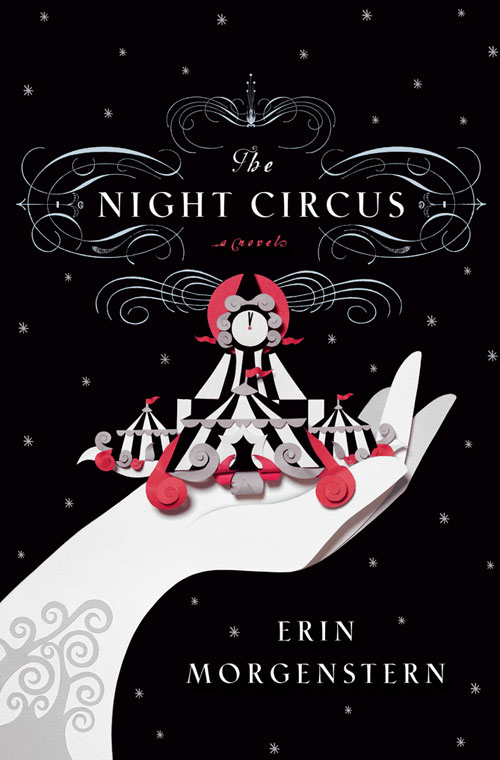
But enough of me going about tarot. The reason all of this is on my mind is that I just read one of the best books I've ever encountered in modern fiction: The Night Circus. IT IS AMAZING. I bring it up because it's all about magicians and a tarot reader and a guy who's card is the Magician. And it's absolutely such an amazing, sweet, powerful, romantic book. Everything I want my writing to be, as a matter of fact.

So, long story made longer, I decided to call myself [La Maga] because it encompasses all sorts of things for me. And I'm all about creating stuff - what represents creating better than the infinite possibilities of a magician?

And, yeah, it's one of the first words I ever learned in Italian. Judge me at will.

Also, many many many thanks to [Львица] and [The Question] for dealing with my name change. It's super annoying to go through all those posts. Thanks guys :D

Wednesday, February 1, 2012

Byronic Heroes, Fandoms, and Benedict Cumberbatch.

Benedict Cumberbatch.

I love this name. I could say it all day.

I first saw this actor in a film called Creation, which features Paul Bettany as scientist Charles Darwin. I had no idea what Cumberbatch looked like, who he was or really anything about anything and so I don't remember what part he played; I just saw his name in the credits and I was like, "Sweet ass name! I wish I could use that in a book. But probs can't; 'cause he's famous."

Seriously, I am so cute and dumb sometimes in my cluelessness. Actually just dumb.

And then I got a Tumblr and then I realized Benedict Cumberbatch is in fact very, very famous and plays Sherlock Holmes on the BBC show Sherlock. And then I realized that I cannot believe that a TV show, portraying Sherlock Holmes in the modern age, has been on for two seasons and I was just now realizing it existed (in my defense, it's a BBC show. And I don't have cable. Or live in the UK). So I of course had to watch it. Which I did, very luckily finding the first episode, "A Study in Pink" on PBS (for free! You go, PBS).


OH. MY. GOD. I know people on Tumblr obsess of this show like there's no tomorrow. And now I see why. IT IS INCREDIBLE. Seriously, I feel like someone reached into my head, dug around for how I envisioned Sherlock Holmes and Dr. John Watson, put them in the 21st century and made it all PERFECT.

I know, I know. I'm being a total fan girl after seeing only one episode. I'd apologize but I'm not sorry. However, I would like to explain that this all has a perfectly understandable source. His name is Sir Arthur Conan Doyle. And created the first fandom.

You see, back when Doyle (WHO WAS SCOTTISH!!!)'s stories first came out in the late 1800s via serial magazine, people got pretty attached. I mean, I think it's perfectly understandable: Holmes is logical, able to solve any case, eccentric, and totally BAMF. Also, he's not so perfect - he's got a bit of a drug habit, is arrogant, not so tact, and admits himself that if things were different, he'd probably be a serial killer. Clearly, the public then agrees with me - Byronic heroes are FUCKING AWESOME.

But the Doyle got tired of writing about Sherlock Holmes. So, trying to write himself out of this quandary, he decided to pen a story in which Holmes is killed by his nemesis, Moriarty. If your favorite character has ever died in any TV show/movie/novel, you can imagine how people reacted.

They, of course, flipped a bitch.

So Doyle had no choice but to resurrect the brilliant Holmes and cleverly find a way he could have survived. And there you have it - the first fandom.

You can probably see why I like Holmes, what with my penchant for Byronic heroes. He's tied with Edward Rochester on my list of hottest fictional characters ever (but I didn't just admit that). Add that to murder mysteries meets science and logic pre-CSI and it is pretty much the most fantastic thing ever. I have read every one of these stories/books twice (except for "A Study in Scarlet," which I just reread a week or so ago, so that makes that one three times read). I've been a total Sherlock Holmes geek since I was 15 or so, and I love how popular Holmes has become (again) in the last few years. I mean, there's a Holmes museum here at the U! (why in Minnesota, I've no idea, but I really have got to check it out some time). Plus there's the Robert Downy Jr/Jude Law Sherlock films, which are pretty good, and a Masterpiece Theater movie with Rupert Everett I saw ages ago which was good too. But I think Sherlock hits the mark best: yes, it's modern, but something about the dynamics between Holmes and Watson, the way the mysteries unfold, the vibe of the tale - it just works. And the way it reflects the original stories is very, very clever.

Also, I feel I am being slowly sucked into the legions of fan girls swooning over Benedict Cumberbatch, obsessing over his eyes, his cheekbones, and declaring that they will marry him (because, somehow, unlike most celebrities fan girls pine after, he is not married). I'm sorry you have crazy fan girls, sir, but you're gorgeous, you're talented, and your voice... Your voice... Here is how Urban Dictionary describes it:
he...has a gorgeous voice 'like a jaguar hiding in a cello'
This is not a lie. Seriously. He's got the same sort of vocal timbre that Alan Rickman has. Which is pretty much amazing.

So there you go: between Doctor Who, Torchwood, and Sherlock, I think I should have enough Byrnoic heroes to obsess over for quite some time. And another British actor to add to my list of favorites - seriously, like 85% of that list contains British or Irish actors. That should tell you something, Hollywood :P (Am I still passively-aggressively upset that Michael Fassbender didn't get nominated for an Oscar and this year is Gary Oldman's first EVER nomination? Oh yeah). But I digress.

Moral of the story: Watch Sherlock. And help me come up with ways in which to say Benedict Cumberbatch in everyday conversation. Because I really freaking love his name.

Saturday, December 31, 2011

Dynamic Duos

Okay, I had a minor freak-out Wednesday night about having a loose, festering flap of skin on my gums last night post-wisdom teeth removal but it appears that's all for naught. It was gone by Thursday morning and my jaw is beginning to feel much better - even if eating food is still rather difficult.

Being rather limited to my activities has allowed me to return to back to some good old reading - namely Patrick O'Brian's Aubrey/Maturin series. I've read The Mauritius Command and am working my way through Desolation Island. I'm a little disappointed at the lack of Diana Villiers but maybe that's for the best - she'd probably just make Maturin really upset (more upset at her than he already is now) and make me totally pissed off. So a little break from Villiers drama probably isn't such bad thing for the series.

One things I'm really glad to have back is the epic bromance that is Aubrey and Maturin's relationship (bromance is totally the wrong term for it, but there's only so many times in my day that I get to use it, so forgive me). Seriously, these guys have a fantastic friendship. The way they interact with each other is really amusing and, well, real. They're a really powerful duo, even if they don't always get along, and I think that's one reason I find the books so fascinating.

And being the Doctor Who geek I've become, I can't help comparing Captain Jack Aubrey and Doctor Stephen Maturin to Captain Jack Harkness and the Doctor from Doctor Who. Admittedly, I haven't seen A LOT of Doctor Who with Jack Harkness yet (only season one) but the interaction I've seen so far between the Doctor and Captain Jack is pretty fantastic. Also, picturing a cross-over between the two series is awesome - I think both Captain Jacks would have some pretty fun conversations (especially with Aubrey's tenancies of being a ladies' man, and Harkness being flirtatious with anyone and everyone). And both Doctors would have some pretty great discussions, I think.


Doctor, meet the Doctor. Captain Jack, meet Captain Jack. Let the weirdness of this moment commence.
(Side note - do you know how hard it was to find an picture of Jack in the Doctor together without them snogging? Rather more difficult than I'd presumed :P)

Monday, November 28, 2011

Complain about Jane

http://bookielaura.blogspot.com/2011/01/jane-by-april-linder.html
Barnes and Noble has made me sad about life... at least my suburban location has. Aside from the tons of vampire teen lit they now carry, the obsession with the Nook, and the lack of Doctor Who DVDs, I came across a book called Jane in the teen section. Intrigued, I picked it up - and immediately regretted it.

It's a modernization of Jane Eyre. And that offends me. Probably because Jane Eyre is my most favorite book in the entire universe.

A modernization would be okay, except for how it's done. Here's the description from Barnes and Noble:

Forced to drop out of an esteemed East Coast college after the sudden death of her parents, Jane Moore takes a nanny job at Thornfield Park, the estate of Nico Rathburn, a world-famous rock star on the brink of a huge comeback. Practical and independent, Jane reluctantly becomes entranced by her magnetic and brooding employer and finds herself in the midst of a forbidden romance.
But there's a mystery at Thornfield, and Jane's much-envied relationship with Nico is soon tested by an agonizing secret from his past. Torn between her feelings for Nico and his fateful secret, Jane must decide: Does being true to herself mean giving up on true love?
Rochester is a rock star? Are you SERIOUS? That's like... oh, I dunno, making Mr. Darcy an UNDERWEAR MODEL. If I wanted to read about a girl meeting a rock star, I'd read every other romance novel EVER.

WHAT IS THE WORLD COMING TOO?!

Sorry, sorry - Jane Eyre and Mr. Rochester are rather sacred to me. Perhaps the book is perfectly good in its own right, but I don't want to hear about any comparisons between the two. I haven't read the book, but this Nico person sounds completely different from Rochester - and thus it's not the same story. And now I'm getting all defensive over fictional characters because...

http://www.someecards.com/usercards/viewcard/eefa97839efa80ab6a34c9d9c10b8296
Shut up, e-cards. No one cares what you think.

Monday, November 14, 2011

Live Life Longer with Science, Part II

Found this opinion article in the Minnesota Daily today: Age is a disease.

As my professor Robin always says, "I love it when life hands me exactly what I'm looking for." Indeed this was the case today.

Oh, college newspapers... you always have such interesting articles. Especially ones that take concepts expressed in Hollywood films and connects them to real life. I feel torn between this article. I mean, obviously, the writer makes an interesting point. But I just can't align myself to his way of thinking. Age just a disease? Maybe I'm being too fatalistic here, but I don't think you can avoid death. I'm not so sure you should.

Don't get me wrong - I'm as terrified of dying as the next person. But something in the back of my head clamors about Doctor Frankenstein and playing God and that maybe science can go too far. But other species die. All animals die. Why are we the ones to change it? I'm not saying there couldn't be an answer to this... but it just seems difficult to overcome.

I guess what fascinates me most about this article is that it deals with senescence ("the accumulation of damage to a person's body over time," the writer describes). Which, in my novel attempt, that's exactly what the people who become immortal have lost - their bodies no longer age and they remain where they are, "a fixed point in time and space," I believe are the words Doctor Who would use. It's an interesting, double-edged sword, both wonderful and terrible. Living forever would be great - or would it? The novel Tuck Everlasting shows other wise and Doctor Who and Torchwood certainly shows the downsides. And the writer of this article engages a debate with the movie In Time's approach to dealing with over-population. But could the solution to curing diseases like cancer and Alzheimer's really be found through such a route as dealing with senescence? Is that really the best path to take?


And thus the debate continues...

Monday, October 31, 2011

Good And Evil

Yesterday, while I was at home, I had the sudden urge to add all the albums that I have of musicals onto my iPod. I haven't done this before because of space issues on my computer but now that my iTunes is on a back-up drive...well, I can add as many songs as I want.

So after this epic upload, I was listening to the music from one of my favorite shows, Jekyll and Hyde. I got obsessed with it in 2002 when I discovered Linda Eder (a Broadway performer who was raised in Minnesota). I seriously listened to this soundtrack for nearly the entire winter, so now that whenever I listen to it after not hearing it for a long time, the first thing I see is snowfall and Christmas lights. I was also lucky enough to see it performed by Burnsville High School, who has one of the most incredible theater programs in the south suburbs. They were even doing a showing of it somewhere in Scotland as I saw ads for it in Glasgow and regretted the fact that there was no way I was going to be able to go. Despite the fact that it's not that well-known and the music isn't quite as spectacular as some shows, I suppose, I'm still a fan. Perhaps because it's based off of one of my favorite creepy stories by Robert Louis Stevenson.

Man is not one but two/ He is evil and good/ And he walks the fine line we'd all cross if we could. That's part of the chorus in one of the main songs, "Facade." If Henry Jekyll were working today, he'd probably be a psychologist trying to understand human nature. Unfortunately from him, that probably wouldn't save him from spiraling into taking experimentation too far and using himself to release his evil side. Which doesn't work out so hot. Because now he's just a normal man, both good and evil (leaning more towards good) with a totally evil maniac trying to escape from him. The musical of this saga is dark and powerful and really chilling (especially when you're listening to it amongst a misty October afternoon). This is one of my favorite songs that just haunts me:


I love the voice of the actor that sings this too - it's so emotional. Also, you can hear a bit of the voice he uses for Hyde lingering in some of the words, and it's super eerie.

This show is just tragic and utterly Byronic, I'm sure. A good man being corrupted by his faults though he intended to do good with his work - how much more of a tortured hero can you get? I also like that this adaption takes into account the women in Jekyll's life, something I always wondered about when I read Stevenson's story (because there were no women in that story and nothing make me wonder more about something than not addressing it all). There are some REALLY great pieces for the women characters in this show and I could share all of them, because some of them are SUPER FANTASTIC. I'm not, though, because that'd probably be tedious and annoying. Instead, I'm going to recommend two - "A New Life" and "In His Eyes." And I'm going to play the one that, for some reason, I just can't get out of my head today. It's really short, not super spectacular, but I just keep singing it to myself. So here it is - "Emma's Reason," a song where Emma, Jekyll's fiance, stands up for wanting to marry him even though everyone thinks he's bonkers. This isn't the whole song, but I can't find it in it's entirety, in English and without any extra weird stuff. So this'll do:


I don't know what makes this show so obsessive for me, but now I can't stop listening to it. A great soundtrack for Halloween, though, I must say.

Tuesday, October 25, 2011

Theory Land, Part II

So a few weeks ago I wrote a blog about a book I was reading by  Henri Lefebvre, called Critique of Everyday Life. It was interesting and there were parts of it I really enjoyed but other things I took offense to. Like Lefebvre saying man doesn't understand his own life. I was pissed by this statement, but, after discussing him some in class, I feel I might have misconstrued his statement.

1) He personally may not have meant this the way I took it. He could have been stating another position of a form of thinking he later critiques, namely Heidegger phenomenology. Often authors of this sort of theoretical writing state opinions of other thinkers and, when you read as much as I must for class, sometimes it gets a bit confusing if they are stating their own views or someone else's.

2) He doesn't mean what I think he means. It could be he's not saying people don't pay attention to their own lives but that they don't pay attention to everything in their lives. Cultural studies is known for closely studying things that other fields of study don't think of as super important at times (which I tend to forget, constantly immersed in CSCL and surrounded by people who find it interesting as well). I mean, you don't see too many books analyzing alienation in the social sciences - it's hard to put in terms of an experiment. Difficult, but not impossible (sticking up for the psychologists too, man!) Also, studying what's right in front of your nose is hard to do. Especially when you're trying to juggle work and family and everything else in your everyday life. Then it gets a bit difficult to look at your everyday life.

3) Maybe we don't know our own lives. We can't know everything about ourselves, after all. However, this may not be such a bad thing. Mystery and unanswerable questions are huge parts of Cultural studies - and life itself. Lefebvre sticks up for naivete in life and that it's an important part of living in everyday life. He sticks up for ingenuous individuals in order to keep pretentiousness out of intellectualism.

So, there's that. However, I still disagree with parts of Lefebvre's argument against things like Surrealism. Yes, sarcasm and cynicism all the time is unhealthy. However, don't make me feel bad for wanting escapism sometimes. Yes, I want to work for Torchwood. That's because I'm not avoiding modern life but because I need a different outlook every once in a while. And I would argue that Torchwood and Doctor Who, while being sci-fi, don't ignore everyday life but rather view it in a different form. But that's an argument for another time.

Hey, maybe the real reason I'm obsessed with watching sci-fi shows is to escape from the cultural theory that's invading my mind. And because Torchwood/Who are just flipping amazing shows. What a convenient way to end this post - with another Torchwood/Who reference. Win :D

I think I make this exact expression after reading too much about base/superstructure.

Tuesday, October 18, 2011

As I Lay Dying

I finished reading Faulkner's As I Lay Dying yesterday, while sitting in this little study hall/ cafeteria that reminds me of my father's alma mater. I got this cool, intellectual feeling sitting there, letting Faulkner's prose flow over me, and began thinking about how much death has come up in my thoughts this month. I don't mean to be overly morbid, but it HAS been a common theme. For one, I'm writing a book about people who can't die. You can see how it would be a common musing. For another, it's the month of All Hallow's Eve and growing closer to Dìa de los Muertos - Day of the Dead. Again, a common theme. Also, people I admire keep dying. And it's terribly depressing.

First it was Steve Jobs (I think I'm still grieving about that, actually. Is that weird? Probably, yes...). And then this weekend during an Indy race, English driver Dan Wheldon died in an accident. This might surprised you that I am a racing fan (only the Indy Series; my parents and I watched NASCAR when I was younger because we used to live in Columbus, IN where Tony Stewart is from, but I don't like NASCAR much. For various reasons that aren't important right now). My fav driver in the series is Dario Franchitti, but I really like Wheldon too - he seemed like such nice, friendly guy. Something I love about the Indy Series over NASCAR is that they seem better able to keep their cool and less... I don't know, Hollywood. They seem more down to earth. And I really respect people like Wheldon who can drive a car like that and be really damn good at it. It's just so sad how he died - something about racing accidents just haunt me. Well, car accidents in general, but especially racing ones. I remember seeing Dale Earnheardt's fatal wreck on TV when I was 10 - it was one of the first NASCAR races I watched too. There's something scarring and terrible about seeing such a terrible wreck on TV with your own eyes, then finding out later that you witnessed a fatal accident. I can't imagine what it was like to actually be at the track... that sort of thing would haunt me for a long time.

And to continue this parade of macabre, my college band is playing a Bach piece titled, "Come Sweet Death." To really get us into the mood of the piece (I think I've got the mood down enough, thank you very much) our director had us rehearse it once with the light dimmed. It was totally eerie and chilling, even if we as a group didn't sound as good as this choir. It's just... grim. I mean, it's more about life after death than just death... but still,  it's a momento mori - a reminder of that death is inevitable.


And because I'm a freak, I get reminded of Captain Jack Harkness every time I play this song (okay, if you want to get to the real passion of a piece about seeking release from pain and looking for solace in the afterlife, but is still a really dark, angst-ridden, tormented song, what better way to illustrate this than our dear Torchwood leader who can't ever die. Even after being blown up - yeah, just saw that in season 3. Holy shit, dude. Holy shit). And to top it all off, I had NO IDEA that Owen and Tosh were going to die at the end of Season 2 and now I'm all pissed off about that and THEN Wikipedia ruined the end of season 3 for me by telling me that Ianto dies and now I just want to crawl in a hole because I freaking love Ianto AND WHAT THE HELL, TORCHWOOD WRITERS WHY ARE YOU KILLING EVERYONE?!

Look, I take my sci-fi TV very seriously, apparently (I got really into Buffy freshman year. I mean, I had a dream that [mind ninja] and I were killing vampires. It was terrifying) and I'm terribly saddened that Ianto is going to die within the next three episodes. And it's just another reminder of our eventual lack of control, that we can't help the fact that we die. And it is terribly, terribly hard to deal with. Nay, impossible.

Yet, somehow, Faulkner makes me feel better. Not that he is comforting - he's really not, with his gritty, complex, grim ideas. But he's honest. And I like that. He doesn't always make complete sense. But neither does life. He wonderfully captures the difficulties of living, of dying, of grieving. And somehow, he makes it sort of beautiful. The same way Bach does with his tragic piece. The way momento moris are - great and terrible and beautiful. I guess what I like about all these things is that they articulate the mystery - the unknown. The fact that we don't know why things happen the way they do, why death is a necessary part of life, why it is so hard to deal with, why we think about death while other creatures don't, why accidents happen, why people like Wheldon and Jobs die too soon. We just don't know. And there's something comforting to know that we as individuals are not the only ones who think about this; it's a sort of strange way of uniting us socially, to know that we worry about the same things, that we are not completely alone. Perhaps thinking about death is important, a way of reminding us that time is limited, that people are important in our lives. Maybe I'm not really being morbid. Maybe I'm just being human.

Sunday, October 2, 2011

Pissed

I saw this on "the Twitter": Scots ban on supermarket alcohol deals come into force
.... *sigh*...
Just... *sigh*...


I am aware that Scotland has issues with their drinking culture. I am also aware that much of Britain, Ireland, Russia, parts of America - the list goes on, I'm sure - also has various such issues.

But my personal interaction with drinking in Scotland has been... well, memorable.

Story #1:
[X] kept getting pissed off (by which I mean angry) whenever she would get carded (or passported, technically) in Glasgow pubs. I was actually kind of thrilled. Yes, it means that they have reason to doubt we were under 18 when we were actually 20. And probably because she assumes that alcohol is loosely handed out in Scotland (see above article for why this is NOT EXACTLY TRUE).  BUT being carded is part of being an adult. Yay for what's going to happen to me every time I order a drink until my hair turns grey!

Story #2
It was our last full night in Edinburgh and we were watching a Manchester United versus Barcelona soccer - I mean football - I mean calcio - I mean that sport where they kick that black-and-white ball around - in the pub in the basement of our hostel. I was hanging out with [No-Mr-Darcy] and [bromandawg] while [X] was drinking way too much hard cider with [one-complicated-lesbian] upstairs. It was rather noisy as some DJ started playing weird electronic music after the game ended so the three of us headed out to the patio to get some fresh air and to hear ourselves think. Outside was a group of British chaps dressed in hunting gear. Ridiculous turn-of-the-century clothes and false mustaches and such. And one guy was dressed like a stereotype of an Italian chef. Now, let me set this up properly. They were staying in the hostel as well, as [X] and I had seen them at breakfast, eating their beans and toast and eggs and usual English/Scottish breakfast fare. Except that they were accompanying their meals with gin and tonics. Solid. By this point in the evening, they were totally hammered. One man in hunting gear started insulting some woman who came outside, calling her a fat cow. She started yelling insults back. Then he... *ahem*... revealed himself to her. She was flabbergasted and returned inside. Til this point, the man had had his back to me. But he continued to keep his crown jewels out in the open, displaying them for the world. I saw them in all their glory as he announced, "You know what I love... is that my bollocks are so pure." [bromandawg] and [No-Mr-Darcy] were embarrassed beyond belief and tried to over-chivalrously apologize. Meanwhile, I was trying not to die laughing. Needless to say it was a bit awkward when I saw him in the breakfast line the next morning. Perhaps God took mercy on him and he didn't remember a thing.

But for every humorous story like that, there's twenty more like this...

Wednesday, September 28, 2011

Renaissance Men and Byronic Heroes

I wonder if psych majors have a difficult managing their relationships.

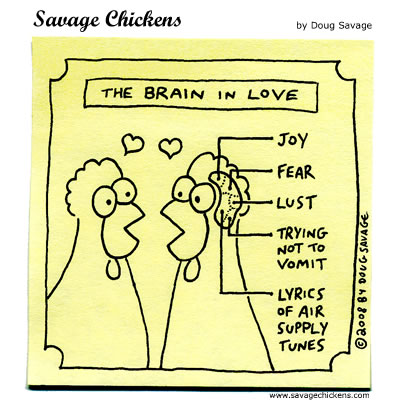
I thought of this as I read a chapter of my social psychology book on "the self." It started after this section on self-awareness (the idea that when people focus on themselves, they compare themselves to... well, themselves; their own values and such. It seems obvious, but that way we're on the same page):

Even when we are self-aware and introspect to our heart's content, it can be difficult to know why we feel the way we do. Imagine trying to decide why you love someone. Being in love typically makes you feel giddy, euphoric, and preoccupied; in fact, the ancient Greeks thought love was a sickness. But why do you feel this way? Exactly what is it about your sweetheart that makes you fall in love? We know it is something about out loved one's looks, personality, values, and background. But precisely what? How can we possibly describe the special chemistry that exists between two people? A friend of ours once told us he was in love with a woman because she played the saxophone. Was this really the reason? The heart works in such mysterious ways that it is difficult to tell.  (pages 125-126, Aronson, Wilson, Akert - Social Psychology, 7th edition)

After this, they site an example from the "old" TV show Friends (seriously, they call it old. Thanks for making me feel ancient, textbook) when Ross makes a list of things he likes and doesn't like about Rachel. This is, according to the author's, a very bad idea.

Consider people like Ross who try to analyze why they feel the way they do about a romantic partner. When people list reasons in this manner, they often change their attitudes toward their partners, at least temporarily... Why? It is difficult to dissect the exact causes of our romantic feelings so we latch on to reasons that sound good and that happen to be on our minds (remember our friend who claimed he was in love with a woman because she played the saxophone?). (page 128, Aronson, Wilson, Akert)


This causes issues for us when we make lists and then list strange things about a person (the textbook mentions a partner annoyingly smacking their gum) instead of more complex things like good chemistry. Thus if we focus on things like gum smacking, we might suddenly decide we're not really in love with our partner and break up with them, then later regret it.

And to make matters even WORSE, the authors mention a study done where men and women are startled on a bridge and the men either immediately evaluated how attracted they were to the woman or asked to evaluate after they crossed the bridge. Those that were evaluated immediately while still startled rated the women as more attractive than those who had calmed down. This "misattribution of arousal" has been found to be true in both women and men. "The moral is this:" the authors say, "If you encounter an attractive man or woman and your heart is going thump-thump, think carefully about why you are aroused - you might fall in love for the wrong reasons!" (page 135, Aronson, Wilson, Akert)

Tuesday, September 20, 2011

A fight for realism?

"Hollywood always wanted me to be pretty, but I fought for realism." ~ Bette Davis

It seems like talking about British culture has become today's theme. But then again, I've been thinking about it a lot lately. Mainly because I've been watching a lot of British television and missing bits about Scotland (the rain every day, the beer, the feeling of everything being foreign and yet so similar...)

Among those things, another sort of thing has enchanted me about British media, something I've noticed in novels and on TV shows. There seems to be a sort of trend of using female leads that aren't your traditional Hollywood types. They seem to appear in mysteries series or sci-fi genres (the ones I'm thinking of are the books The Eyre Affair, The Dead Lie Down, The Likeness and, you knew this was coming, the TV show Torchwood). They feature quirky, not-traditionally beautiful women who aren't afraid to speak their minds and do what needs to be done, even though they may not want to. They make mistakes. They're compassionate while still strong and not overly sexual. But they're still sensual and feminine - just not over the top. Over the top like how in CSI, Catherine Willows is always running around in tanktops and all the guys are in their full investigation gear.

Catharine Willows, CSI


Gwen Cooper, Torchwood


See the difference?

This is even a more glammed up version of Gwen, I feel like. I mean, the first time we meet her on the show, she's in full police gear with her hair all tucked up under her hat. No Catharine-like waves in sight.

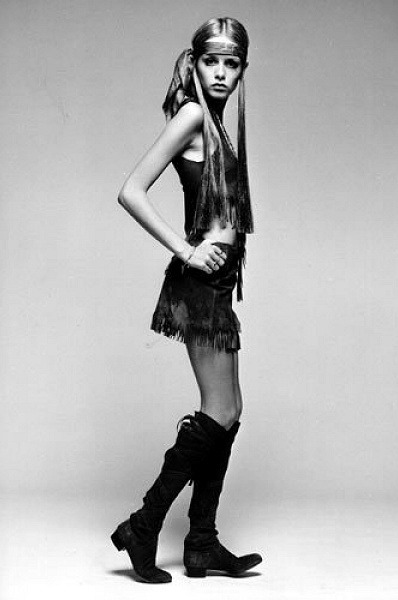
Of course, I have to remind myself that England was also the country that gave us Twiggy. And thus in association, pants that will never fit women's hips. Of course, I guess the really scary thing is I look at Twiggy and think, "Oh, she's not that skinny." Then I take a closer look at her arms and I'm like, "Fuck yeah, she is." But then I think again, "No, not really - there's girls in my classes who look like that." Then I just feel weird and pissed off.
Twiggy, you're wonderful, but I hate you.

It's true that super skinny women have become WAY more common. Not so much in college, because people have finally realized that you can't walk a mile to class each day and not eat more to compensate. But high school totally sucked because it seemed like what like 50% of the girls (but was probably more like 10%) were frightfully skinny. And I, of course, was not. Example of what some of the girls at my school were like. One of my classmates got treated for bulimia and when she came back to school from rehab, the first thing one of her so-called-friends said was, I kid you not, "She looks so fat." And people wonder why kids hate going to school.

So, to say the least, it's certainly nice to see women like Gwen Cooper on TV, who are beautiful not because they're scantily clad or because they're super skinny or shit like that. It's nice that Gwen has imperfect teeth and seems to be of normalish body weight. Girls need to see more of this on TV, in books, everywhere. Why can't women be the way they look in real life? There's a difference between creating an imagined world and representing one person's idea of a utopia. Besides, beauty isn't the same think to everyone. Perhaps we're looking for it in all the wrong places. Maybe it's something simpler, more in line with this:

“The beauty of a woman is not in the clothes she wears, the figure that she carries, or the way she combs her hair. The beauty of a woman is seen in her eyes, because that is the doorway to her heart, the place where love resides. True beauty in a woman is reflected in her soul. It's the caring that she lovingly gives, the passion that she shows and the beauty of a woman only grows with passing years.” ~ Audrey Hepburn

It's not that appearance doesn't matter; it clearly does. But it's all about belief, confidence and your eyes. If YOU believe that you are beautiful, if you truly TRULY LOVE yourself, it will show. Of course, this is all easier said than done. But I believe it to be true. There is no one definition of beauty, and if there was, all of the people we consider to be beautiful would all look the same. And people like Paris Hilton would be more popular than Angelina Joli. But I think Audrey Hepburn's idea of beauty if more spot on and more of what these British female characters are beginning to show more of. So work on this, American TV. I'm a little out of touch with some of your shows, so maybe you've gotten better about this. But then again, we've still got this goddamn show:


Tuesday, September 13, 2011

Bisexuals and eternity, or: yes, this is what I spend my spare time pondering

As I stated previously, the BBC show Torchwood has begun to take over my life. So much so that this strange unidentifiable bugs that inhabit our apartment building have earned the name "weevil bugs" even though they don't look like the actually weevil or the weevils from the TV show. But calling them weevil bugs at least incorporates how alien they look.
An actual weevil. I could make a Master and Commander reference, but I'll spare you.
A weevil from Torchwood. I think this one is named Janet.
What we're dealing with.... gross gross gross gross gross gross.

Upon looking for images of our little "weevil bug" I have since discovered that our strange creature is in fact centipedes. WHICH I LOATHE.  Seriously, they are one of my least favorite insects ever. FUCK. Well, I'm still going to call them "weevil bugs." Because for some reason naming them after aliens from a TV show somehow makes them less terrifying than calling them by their real names. Unless they start actually looking like weevils... *ugh*

Anyway, I digress. Point is, I'm obsessed with this show. It's killing me that we know that the main character Jack Harkness can live forever but we don't really know who he is, what's happened to him, how he joined the organization Torchwood. Thus the reason the show is so damn addicting. But over the course of watching the first season (we're into the second season now, yay!) I've noticed something - though the show focuses on relationships with Jack  that usually involve men, the writers have also hinted at heterosexual relationships (note season 1, episode 5 - "Small Worlds," for those who are as nerdy as me :p). Which reminded me, strangely enough of another sci-fi/fantasy series I'm interested in - namely, Cassandra Clare's The Mortal Instruments series.

Sunday, August 21, 2011

You remind me of me... but bitch, please

I could kill Diana Villiers right now. This brings about two problems:
1) I want to kill an individual.
2) I want to kill an individual who is fictional.
Which, ultimately, brings me to a third problem:
3) I am jealous of a fictional individual.

I should explain. Diana Villiers is a character in Patrick O'Brian's Aubrey/Maturin series (aka, the series that the movie Master and Commander is based on). Diana is a fascinating character, especially given the time period she inhabits. She's a short, dark-haired smartass who goes horseback riding and fox hunting, plays the piano even though she can't read music and won't listen to her aunt's plans for her life. She grew up in India, fell passionately in love with a man who did not make a "profitable" match, but whom she married none the less. After he died, she returned to England, a black sheep in her family of gentle lambs. Needless to say, I love this maniac. She's the sort of character I've been dying to see in Regency era novels ever since I first met Elizabeth Bennet. Don't get me wrong, Jane Austen's Elizabeth is fabulous; I like her a lot. But I always longed for a character that incorporated both Elizabeth's free-thinking and Emma Woodhouse's sharp tongue. With Diana, I get the perfect match. Which, interestingly, creates the sort of girl I try to be.

Thursday, August 18, 2011

The sea, the sea, it calls to me...

Remember that thing I started about keeping a list of things I'm happy about? Well, this is a continuation of that. So deal with it.

3) The sea: I saw it for the first time this year. Well, I sort of saw it when I visited Venice. And when I was in New York. But when I went to Scotland, this time I was up close and personal and it felt real. I saw a jellyfish, for the love of Pete! I know some people have been unimpressed when they finally see the ocean, because they expect it to be so spectacular. I was more than impressed - it absolutely blew away my expectations. The cool sea breezes, the color of the waves, the smell and feel of the rain that fell (it tasted salty! I couldn't believe it!) Weirdly, it made me feel at home. I've always had this huge affinity with water ("it's because I'm a water sign, hahaha" I joke. I'm a Scorpio - yes, that's a water sign. What scorpions have to do with the water, I don't know. But I appreciate the ability to use it as an excuse for something I loved before I even saw it). Thus, my obsession with bodies of water leads to another thing I'm happy about.

4) The movie Master and Commander: I cannot explain why I love this movie (because of all movies, why I'm currently obsessed about this one, I can't say). Mainly, because it's about the sea. And based on my previous post, you can tell I like that. Also, it is about the turn of the 19th century, when is a time period I'm obsessed about, for reasons I understand about as much as I understand why I like the sea. The books the movie is based are equally spectacular, if not more so (don't expect the movie to be much like the series; they mix a bunch together but I still think the movie is great on its own). Also said movie connects to yet another thing on my list… which will be spoken of in another post :)

Monday, August 8, 2011

Pensive Pooping Teddy Bear Takes On World


Okay, so after the insanity that was yesterday's posts, I'm going to write something very short and sweet about a book I just reread - Winkie, by Clifford Chase. Here's the gist: it's about a teddy bear that comes to life, experiences life (as in walking, talking, eating and pooping) and gives birth to a baby bear ("Baby Winkie"), only to suffer tragedy and despair and to be accused of terrorism by the FBI. Yes, you read that right - a teddy bear is accused of terrorism. As ridiculous as it sounds, it's a really interesting book, and well-written considering the strange plot. So look it up if you're interested in inanimate objects acquiring life and someone poking fun at the US justice system. And pensive pooping teddy bears, of course.

Tuesday, July 26, 2011

Death and all his friends

Okay, so I wrote this blog for another blog (for one of my classes) but I really like it and want to save it. So forgive my recycling. Basically, this is about the book White Noise (which is fantastic - read it) and how the main character thinks about history. We could only site three passages and were limited to how many of those passages could be directly about history or death. Anyway, I had fun writing this and I'm too lazy to write anything new right now :P

This is going to be a bit tricky, summing up Jack Gladney’s understanding of history without referring to any other passages in the book, as I think I’ve developed an obsession for Delillo’s way with worlds, but I’ll give it my best.

Jack has a curious approach to history – yet one that is seems pretty familiar at second glance. He and his son, Heinrich, have a conversation that alludes to his view of history while the two of them are discussing Tommy Roy Foster, the man Heinrich plays chess by mail with and criminal who killed six people in Iron City.

“‘He says if he had to do it all over again, he wouldn’t do it as an ordinary murder, he’d do it as an assassination.’
‘He would select more carefully, kill one famous person, get noticed, make it stick.’
‘He knows he won’t go down in history.’
‘Neither will I.’
‘But you’ve got Hitler.’
‘Yes, I have, haven’t I?’” (45)

This passage shows two basic ways Jack sees history – making it (in this case, killing people, though even that may not be enough for Tommy Roy Foster to be considered important) or studying it, as Jack does; with this we’re back to our first blog post, caught between Ranke and Sam Byck’s methods. This passage also echoes the urge of being remembered, of wanting history to keep note of what happened, even if it is something terrible, as in murder. Like Loughner, Sam Byck and others, Tommy fears being forgotten – a sentiment Jack himself can understand. But as Heinrich reminds him, he has Hitler to fall back on, something to cling to and perhaps, through his creation of Hitler studies, be remembered for his work.

Jack mentions more of his association with Hitler, this time in a conversation with Denise, Babette’s daughter about the Third Reich. 

“‘They lost the war,” she said. “How great could they be?’
‘A valid point. But it’s not a question of greatness. It’s not a question of good and evil. I don’t know what it is. Look at it this way. Some people always wear a favorite color. Some people carry a gun. Some people put on a uniform and feel bigger, stronger, safer. It’s in this area that my obsessions dwell.’" (63)

Jack admits that his study of Hitler is more than just work; it’s an obsession. Connected to this obsession is the idea of belonging to something bigger than oneself – to feel “bigger, stronger, safer” as Jack says. Jack also admits that he doesn’t quite understand why things are this way. Through a simple, basic way of explaining this to Denise, he also works to convince the reader of this stance – that there is something prevalent in history with groups that bond together, whether for better or for worse – in revolutions, in political parties, and (in more current situations) the Tea party. 

Interconnected with his Hitler obsession seems to lie another obsession – death. Jack mentions it repeatedly and towards the end of the chapter, he ruminates on it once again.

“When I read obituaries, I always note the age of the deceased. Automatically I relate this figure to my own age. Four years to go, I think. Nine more years. Two more years and I’m dead. The power of numbers is never more evident than when we use them to speculate on the times of our dying.” (98)

Though he is dealing with small, local histories, reading the obituaries of people from his town, Jack is heavily impacted by this, especially as he has a fear of death, notably dying alone. He also effectively impacts the reader in a personal way, playing off of the idea of running out of time. He and Heinrich discussed this before with Tommy, and now Jack seems to be feeling it himself – he could be dead in two years. Numbers indeed do gain more power in that aspect. This certainly made me think about how I feel about my age. I always cringe a bit when I tell people that I don’t have a boyfriend, have never had a boyfriend and thus feel like I am subtly being judged. My grandmother, who was married by my age, already fears I have become a spinster. Though I’m only twenty (or already twenty, depending on your mindset) there’s already pressure that I’ve missed some specific opportunities in my life and that, as the saying goes, “I’m not getting any younger.” Through fear of missing out on opportunities (like relationships and so on) is there a fear of death? Kind of seems like it, from Jack’s way of thinking.

Life is short, time is running out – all of these common sentiments play into Jack’s worries and these powerful ideas powerfully sway the reader to understand where he is coming from. He worries about death and dying alone, which references his obsession with Hitler and bonding together into a greater entity… which involves more death. And once more, history is focused on dead people and dying. Yay.
Related Posts Plugin for WordPress, Blogger...